Product Description
Firefly Luciferase mRNA enters the cell and expresses the firefly luciferase protein, which catalyzes the oxidation of D-luciferase in an ATP-dependent manner, producing fluorescence at 560nm. Originally extracted from Firefly Photinus pyralis, Firefly Luciferase is commonly used as a bioluminescent reporter gene for gene regulation and function studies, suitable for experiments such as mRNA delivery, translation efficiency, cell viability, and in vivo imaging.
This mRNA contains high level of Cap1 structure at 5' terminal.Compared with the Cap 0 structure, the mRNA with the Cap 1 structure is more suitable for the mammalian system and has a higher transcription efficiency. Modified UTP and addition of poly(A) tails provide higher transcriptional efficiency and inhibit RNA-mediated innate immune activation while enhancing mRNA stability and longevity in vitro and in vivo.
Features
Ready-to-use & Time-saving: Eliminates time-consuming mRNA preparation—ready for immediate transfection or LNP formulation.
High capping efficiency: Features Cap 1 structure, optimized for enhanced compatibility in mammalian systems.
Incorporation of modified nucleotides and poly(A) tail: Mitigates RNA-induced innate immune activation and improves mRNA stability.
High transfection efficiency & Excellent reproducibility: Ensures consistent and reliable experimental results.
Performance
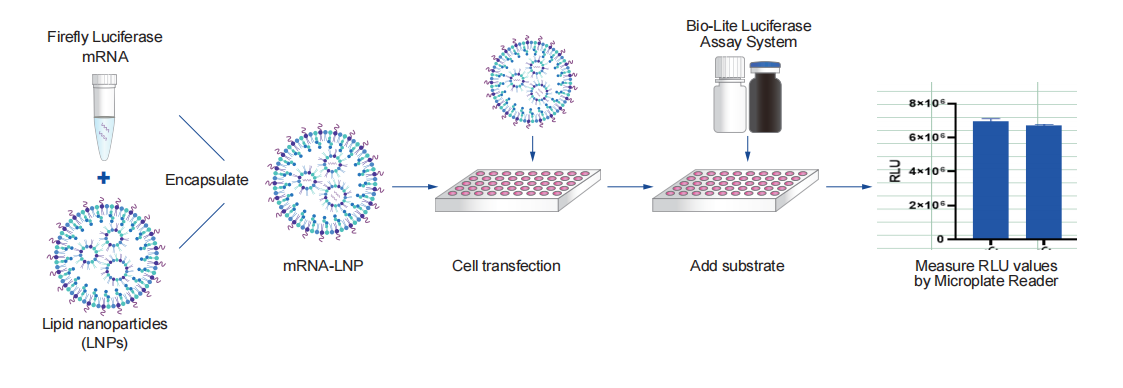
mRNA cell expression process
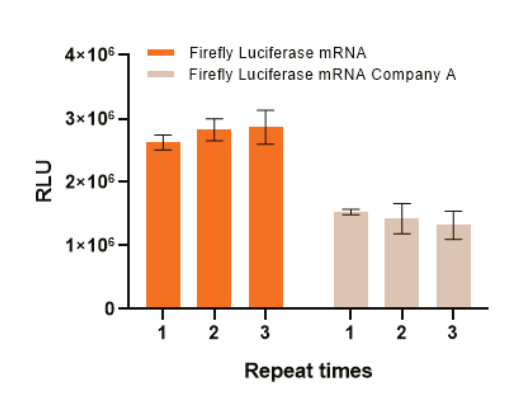
Firefly Luciferase mRNA transfection efficiency in HEK 293T cells 20 hours after transfection
mRNA expression process in mice
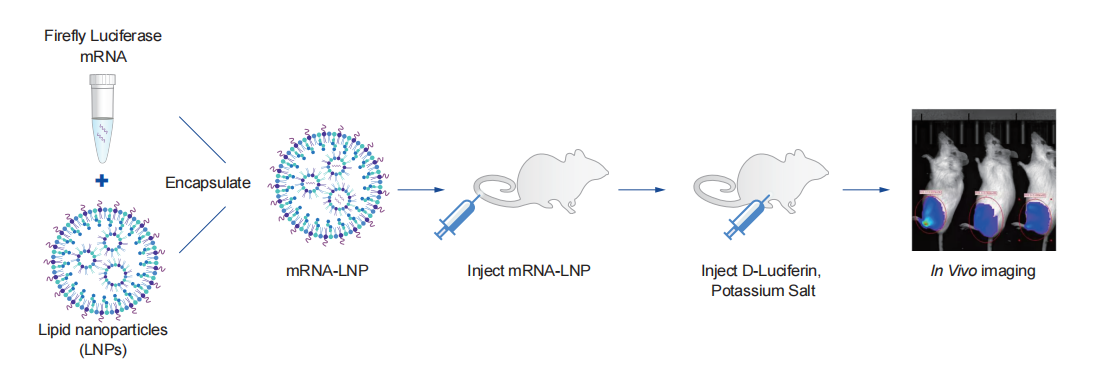
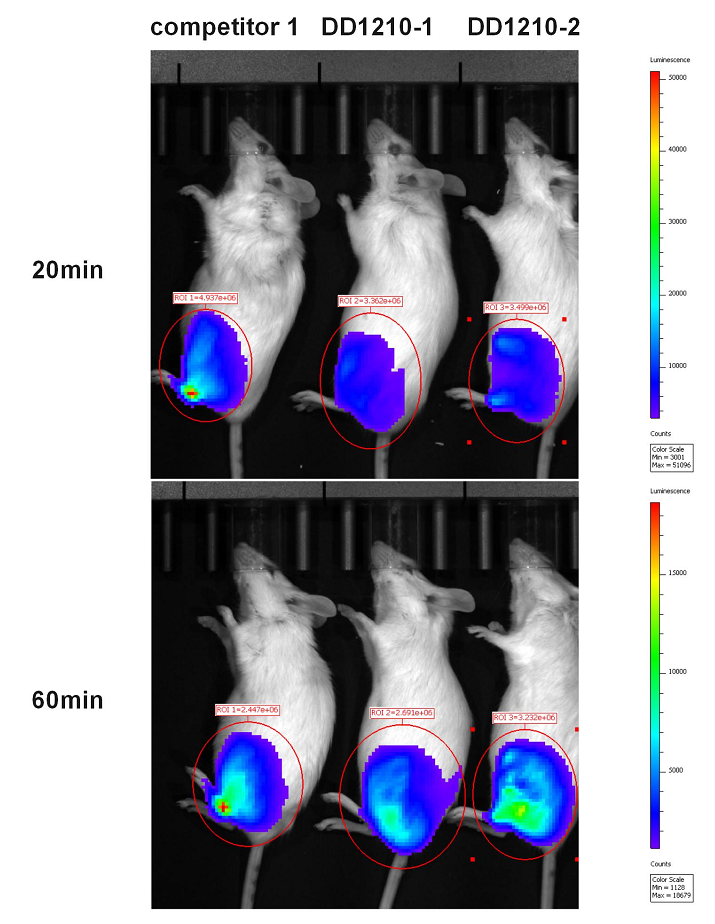
Liposome encapsulated mRNA-Luc model mouse in vivo 60 min imaging detection
Components

Storage
Store at -30~-15℃ and transport at ≤0℃.
FAQS
Frequently Asked Questions1.Q:Are there any recommended delivery systems?For early-stage in vitro screening, we recommend using Trans-IT® or Lipofectamine™ 3000 for RNA transfection. For in vivo delivery systems, there are currently no specific vendor recommendations available.
2.Q:How long can the mRNA stability be maintained after LNP encapsulation?A:The stability duration varies depending on the LNP formulation. It is recommended to determine stability experimentally by measuring mRNA integrity (e.g., via fluorescence-based assays) or protein expression levels in cells.
3. Q: Can you provide the specific sequence of the mRNA?A:The sequence of the reporter gene mRNA is proprietary and confidential R&D information and is not available for public disclosure.