

Product Description
EGFP mRNA expressed enhanced green fluorescent protein (enhanced green fuorescent protein, EGFP), which was initially isolated from jellyfish (Aequorea victoria) with a maximum emission wavelength of 509 nm, and the excited green fluorescence could be easily detected by fluorescence microscopy or flow cytometry. As a reporting mRNA, EGFP mRNA is ideal for monitoring and optimizing transfection efficiency and can be used as a positive control for mRNA transfection.
This mRNA contains high level of Cap1 structure at 5' terminal .Compared with the Cap 0 structure, the mRNA with the Cap 1 structure is more suitable for the mammalian system and has a higher transcription efficiency. Modified UTP and addition of poly(A) tails provide higher transcriptional efficiency and inhibit RNA-mediated innate immune activation while enhancing mRNA stability and longevity in vitro and in vivo.
Features
Ready-to-use & Time-saving: Eliminates time-consuming mRNA preparation—ready for immediate transfection or LNP formulation.
High capping efficiency: Features Cap 1 structure, optimized for enhanced compatibility in mammalian systems.
Incorporation of modified nucleotides and poly(A) tail: Mitigates RNA-induced innate immune activation and improves mRNA stability.
High transfection efficiency & Excellent reproducibility: Ensures consistent and reliable experimental results.
Performance
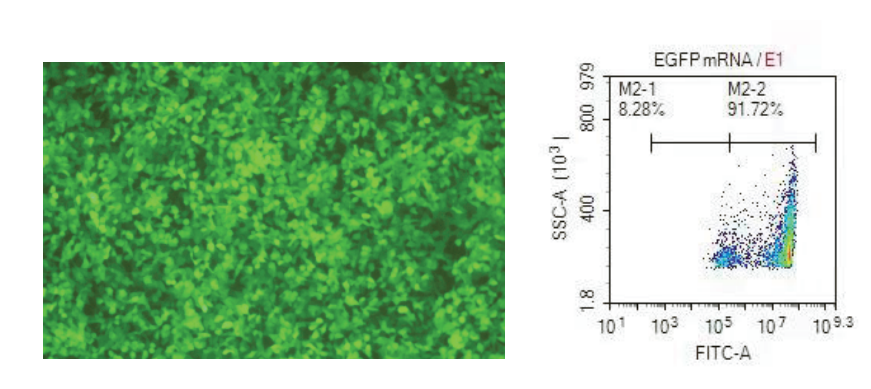
Fluorescence images and flow cytometry plots of Vazyme EGFP mRNA expression in HEK 293T cells 20 hours after transfection.
Components

Storage
Store at -30~-15℃ and transport at ≤0℃.
FAQS
Frequently Asked Questions1.Q:Are there any recommended delivery systems?A:For early-stage in vitro screening, we recommend using Trans-IT® or Lipofectamine™ 3000 for RNA transfection. For in vivo delivery systems, there are currently no specific vendor recommendations available.
2.Q:How long can the mRNA stability be maintained after LNP encapsulation?A:The stability duration varies depending on the LNP formulation. It is recommended to determine stability experimentally by measuring mRNA integrity (e.g., via fluorescence-based assays) or protein expression levels in cells.
3. Q: Can you provide the specific sequence of the mRNA?A:The sequence of the reporter gene mRNA is proprietary and confidential R&D information and is not available for public disclosure.


