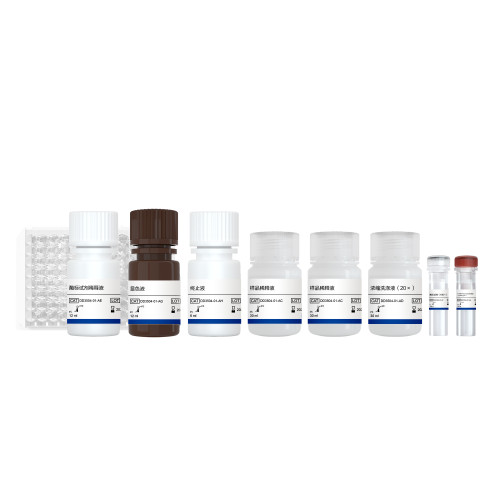
Product Description
This kit employs a fed-batch culture process using CHO to immunize goats for the production of HCP-specific antibodies. The kit is based on a double-antibody sandwich enzyme-linked immunosorbent assay (ELISA) to detect residual CHO-HCPs in biologics process samples. The wells of the ELISA plates are pre-coated with Anti-CHO-HCPs goat polyclonal antibodies. CHO-HCPs calibrators and test samples are added to the solid-phase antibody-coated wells, followed by the addition of the detection antibodies-HRP conjugate. Through a one-step incubation, any residual CHO-HCPs present in the test samples are captured by the solid-phase antibodies and simultaneously detected by the detection antibodies, forming a "coated antibody-(CHO-HCPs antigen)-detection antibodies-HRP conjugate" complex. Unbound substances are removed by washing, and TMB substrate is added for color development. The reaction is then stopped, and the absorbance is measured at dual wavelengths of 450 nm and 630 nm. The absorbance of the samples is positively correlated with the residual amount of CHO-HCPs in the process samples. The concentration of CHO HCPs in the samples can be calculated using a dose-response curve.
Features
Simple operation:One-step procedure, pre-diluted standards
Excellent stability:Shelf life-18 months
Reliable raw materials:Extensive project application experience
Performance
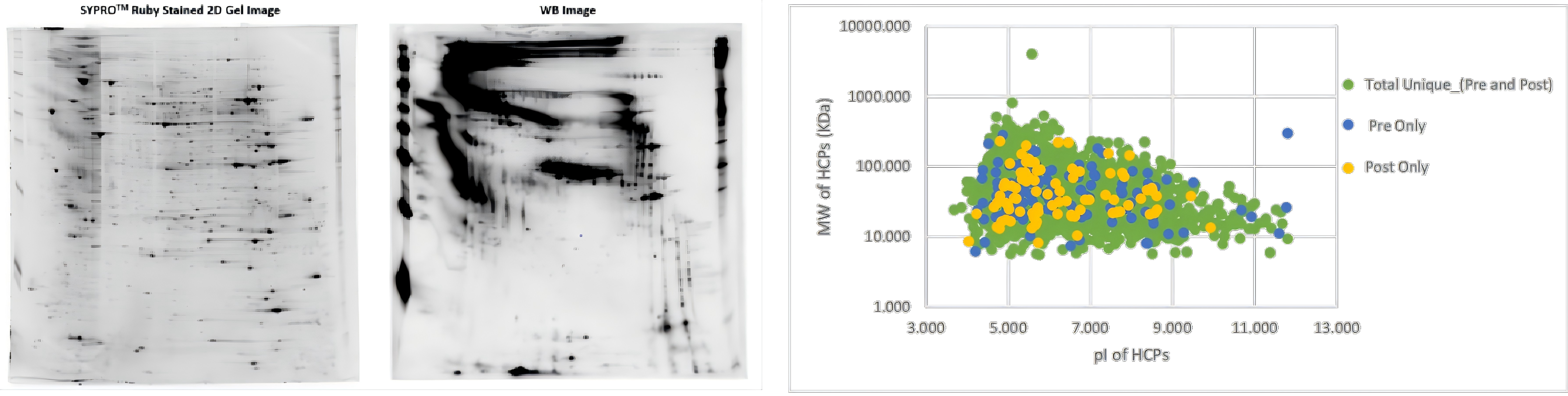
High Coverage Rate
Exhibits broad recognition of HCPs across varying molecular weights and isoelectric points, achieving coverage rates >80% (82% by 2D-Western Blot; 95% by AAE-LC-MS). The antibody pair detects over 2000 distinct CHO HCPs and covers all 25 CHO high-risk HCP.
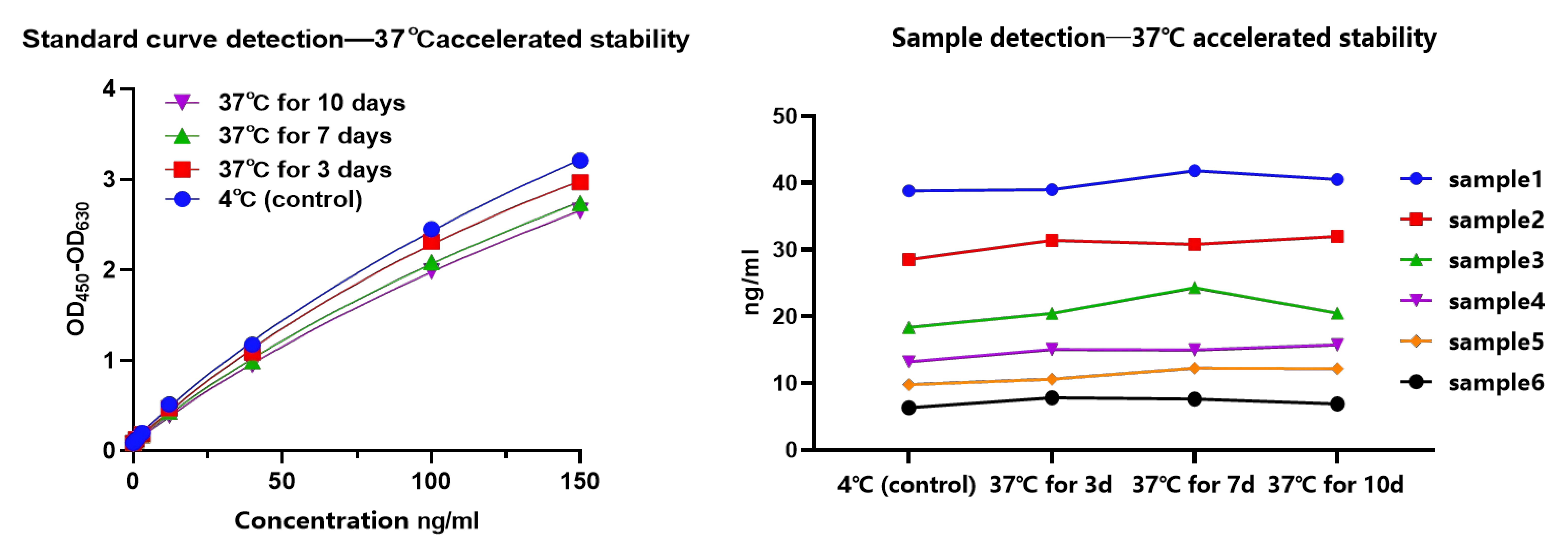
Excellent Kit Stability
Accelerated stability testing of the complete Vazyme DD8102 kit at 37°C. After 10 days of accelerated, the sample reactivity decreased by less than 20%. Furthermore, all critical parameters – LOD, LOQ, accuracy, precision, and specificity – consistently met the product specifications.
Minimal Matrix Effects
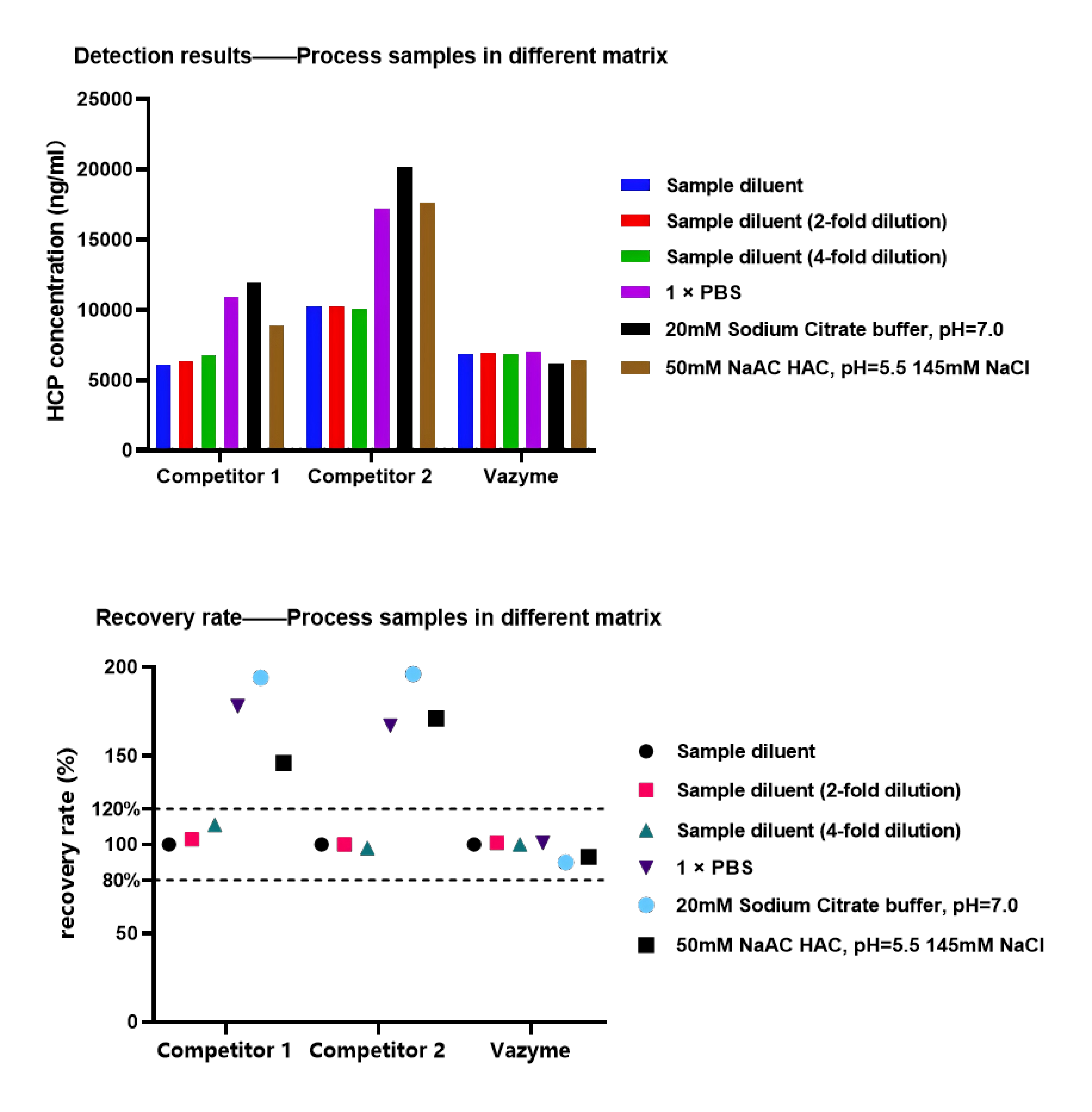
Spike-and-recovery experiments were conducted with process samples of known concentration across various matrices. Vazyme's product demonstrated significantly lower matrix interference and higher accuracy compared to competitor kits, evidenced by smaller variations in detected concentrations and consistently acceptable recovery rates.
Superior Precision and Accuracy
Precision (intra- and inter-assay) and accuracy were evaluated using Quality Controls (QCs) at 5 concentrations prepared from process samples of known concentration. All coefficients of variation (CV) were below 15%, and all biases were within ±20%, confirming the assay meets requirements for precision and accuracy.

Components
Storage
Store at 2 ~ 8°C and ship on ice pack.
FAQS
Frequently Asked Questions1. What methods were used to determine HCP antibody coverage and what were the coverage results?Antibody coverage was assessed using three orthogonal methods: · 2D Western blot (2D-WB): 82% coverage. · AAE-2D DIGE (Antibody Affinity Extraction followed by 2-D Differential Gel Electrophoresis): 99% coverage. · AAE-LC-MS (Antibody Affinity Extraction followed by LC-MS/MS): 95% coverage. These orthogonal approaches (2D-WB, AAE-2D-DIGE, and AAE-LC-MS) provide complementary confirmation of antibody reactivity.
2. Which cell lines/sources has the kit been validated on?The immunogen used to generate the kit antibodies was prepared from CHO K1. Validation by Western blotting shows the kit is suitable for detecting host-cell proteins in samples derived from multiple CHO cell lines, including: CHOK1A4, CHO K1N079, CHO-GSKO, CHO-S, CHO-DUKX, CHO-M, CHO-DXB11, CHO-K1 Horizen GS, and CHO-K1SV.
3. Why can a hook (prozone) effect occur with HCP ELISAs and how can it be mitigated?Mechanism: the kit uses goat polyclonal antibodies coated on the plate that collectively recognize many different HCP species. When total HCP concentration is very high, individual high-abundance HCPs can be present in antigen excess relative to the available corresponding antibody binding sites, causing an antigen-excess (hook/prozone) effect and underestimation of signal. Mitigation: if a hook effect is suspected, adjust the sample dilution strategy: use smaller dilution increments (e.g., 2– to 3-fold steps rather than large jumps), include at least three dilutions that span the assay dynamic range, and ensure at least one dilution falls within the kit’s validated linear range. If hook persists, increase the dilution until the dose–response returns to the expected monotonic behavior.
4. What is the antibody source?The kit antibodies are goat polyclonal antibodies (goat-derived polyclonal antiserum).