Product Description
Phanta Flash Super-Fidelity DNA Polymerase has the characteristics of high fidelity (mismatch rate is 1/106 of conventional Taq DNA polymerase) and rapid amplification (5 sec/kb), by the directed evolution of Phanta DNA Polymerase. With the application of the latest hot-start technology and the addition of specific factors, its amplification specificity and success rate are significantly improved. The amplification products of this product are blunt-ended, which are subsequently applicable for ClonExpress Ultra One Step Cloning Kit V2 (Vazyme #C116) and Ultra-Universal TOPO Cloning Kit (Vazyme #C603).
Features
Flash amplification: Amplification of fragments within 10 kb can be completed in 1 hour
High fidelity: ~106X higher than Taq DNA Polymerase
Broad compatibility: Suitable for crude templates, high GC/AT templates (overall GC 24%-79%, local GC 22%-88%) and methylated templates
Convenient operation: Only ''standalone enzyme + buffer'', makes sample addition easier
Experimental Cases

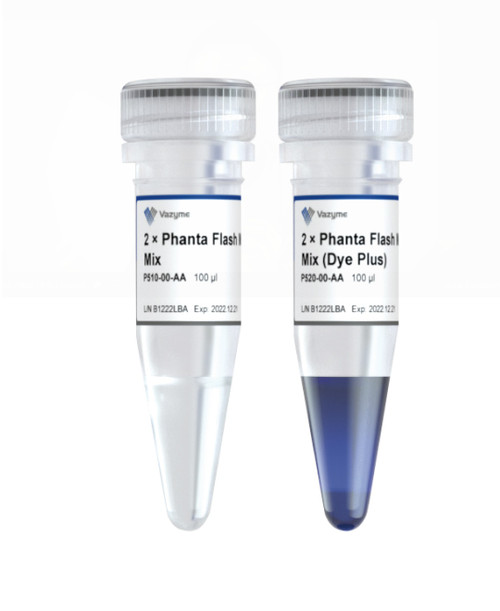
▲ P510 is the master mix format of P521. P520 is the Dye Plus format of P521.
Components

Storage
Store at -30 ~ -15°C and transport at ≤0°C.
FAQ
Q1: Can I perform restriction digestion in the Phanta Flash reaction buffer?
A1: Phanta Flash reaction buffer is compatible with restriction digestion directly after PCR. Note that Phanta Flash Super-Fidelity DNA Polymerase is not inactivated during PCR, thus purification of PCR products before restriction digestion is recommended if intact 5'- or 3'- overhangs are needed for cloning.
Q2: Can I amplify GC-rich targets with Phanta Flash Super-Fidelity DNA Polymerase?
A2: Platinum SuperFi II DNA Polymerase can amplify targets with high GC content (up to 83% GC) without any additional DNA melting agents. In cases of extremely GC-rich targets (>83% GC), addition of DMSO to final concentration of 5% is recommended.
Q3: What are your recommendations when working with long amplicons using Phanta Flash Super-Fidelity DNA Polymerase?
A3: Good lab practices are important for long fragment amplification. These include using high-quality templates (pure, fresh, and intact) and fresh primer solutions. Reducing primer concentration to 0.3 µM may also improve the results.
Q4: What are your recommendations when calculating annealing temperatures using Phanta Flash Super-Fidelity DNA Polymerase?
A4: Approximately 5°C above Tm of primers, but no more than 68°C.