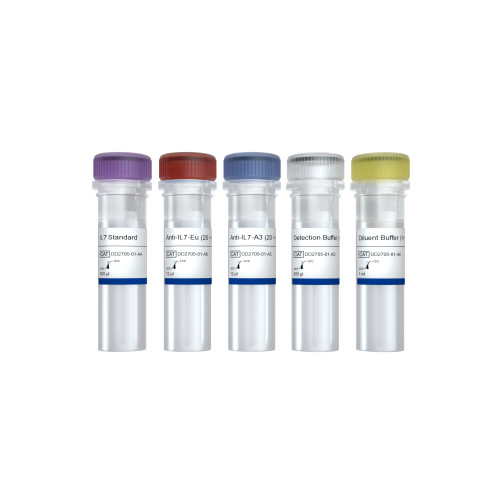
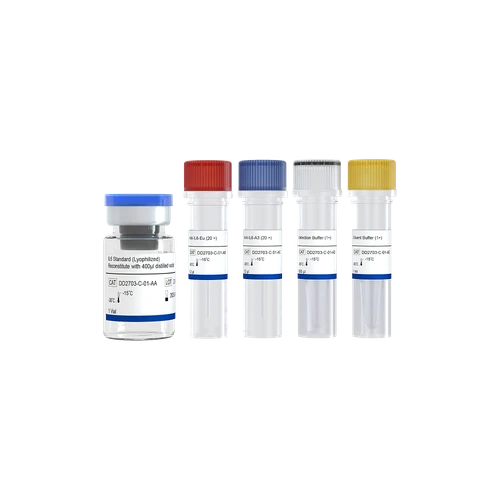
Product Description
cAMP Detection Kit is a competitive immunoassay intended to measure cyclic AMP (cAMP) accumulation in cells. The kit contains an antibody that specifically recognizes cAMP, labeled with a fluorescent donor Eu (Anti-cAMP-Eu), and cAMP is labeled with a fluorescent acceptor A2 (cAMP-A2). In the solution, Anti-cAMP-Eu binds with cAMP-A2, which can lead to Fluorescence Resonance Energy Transfer (FRET). When excited with light at 320 nm, the fluorescent donor Eu emits light at 620 nm. This 620 nm light, in turn, excites the fluorescent acceptor A2, causing it to emit light at 665 nm. After cell lysis, the cAMP produced within the cells is released into the lysate sample, which competes for binding with Anti-cAMP-Eu, disrupting the FRET phenomenon.The FRET signal value (the ratio of light intensity at 665 nm to 620 nm) is inversely proportional to the concentration of cAMP in the standard or sample.
Features
Considering both window and sensitivity
Multiple applications, can be used for Gs or Gi pathway
Time-saving and simplified operation
High-Throughput Screening for GPCR target drugs
Storage
Store at -30 ~ -15℃ and transport at ≤ 0℃.
Stability
Higher stability and longer shelf-life
The standard, donor & acceptor was accelerated at 4℃ for 21 days and freeze-thaw for 5 times. The results showed that CV was less than 10%, indicating that the standard, donor & acceptor was stable, which means it can be stored at -20℃ for 18 months and frozen and thawed for 5 times.
Fig.1 Stability of Standard
Fig.2 Stability of Donor & Acceptor
Case Study
Case study in GPCR Gs/Gi pathway
On Gs (Fig.1) and Gi (Fig.2) cell system, the cAMP were detected by this kit. Results shows the compatibility in Gs and Gi application scenarios.
Fig.1 Validation in Gs (GCGR) Agonist Dose Response

Fig.2 Validation in Gi (CCR5) Agonist Dose Response
Tab.1 EC50 & S/B

FAQ
Q: What kind of plate reader is suitable for Add&Read cAMP detection?
A: Reader equipped with HTRF/TR-FRET modulea.
Q: What kind of sample does this product apply to?
A: Cell samples.
Q: How to preserve the standard after remelting and how long can it last?
A: For the first time, it is suggested that the standard should be stored at -20℃ in separate packages, and it can be used normally within five times of freezing and thawing.
Q: Can cell culture medium be directly added for receptor detection?
A: Yes, we tested some normal medium, but if your culture medium is special, it is recommended to verify it before use.
Q: How to save the use process of the kit?
A: After the kit is received, it can be stored according to the storage conditions in the instructions if it is not opened. After use, it can be stored separately for the reagents and stored at -20℃ and buffer at 4℃.
Q: Have you done the stability data of the kit?
A: At present, the stability of each component in the kit has been tested separately, and each component can be stored for 21 days at 4 ℃.